

News Archive


FUNDED LL.M. OPPORTUNITY IN LAW OF THE STAGES OF HUMAN LIFE
We invite applications from JD students/ JD graduates interested in pursuing a Master in Laws (LLM) project with a focus on how human life cycles are understood. We hope to hear from JD students who have an interest in health law, geriatric law, maternal health law, Indigenous law, and others. The legal and health care communities are becoming aware that their abilities to understand and respect all bodies of knowledge regarding birth, life, and death are still minimal. Co-supervised by Professors Jennifer Chandler and Signa Daum Shanks, the LLM student will have an opportunity to broaden their academic efforts in health law, Indigenous law, and the history of health sciences reinforcing colonizing attitudes about the value of Indigenous knowledge. Finding in thhe amount of $15,000 is available. (English only)
More >

SANTÉSHIP APPLICATIONS OPEN
The application process for "Santéships" is now open! Santéships are opportunities for first-year students enrolled at the University of Ottawa Faculty of Law to be mentored as a research assistant under a professor in the Centre for Health Law, Policy and Ethics in the winter semester of 2023. Successful applicants receive a bursary of $1,000 and engage in a research project within the professor's broader research program (60 hours total).
More >
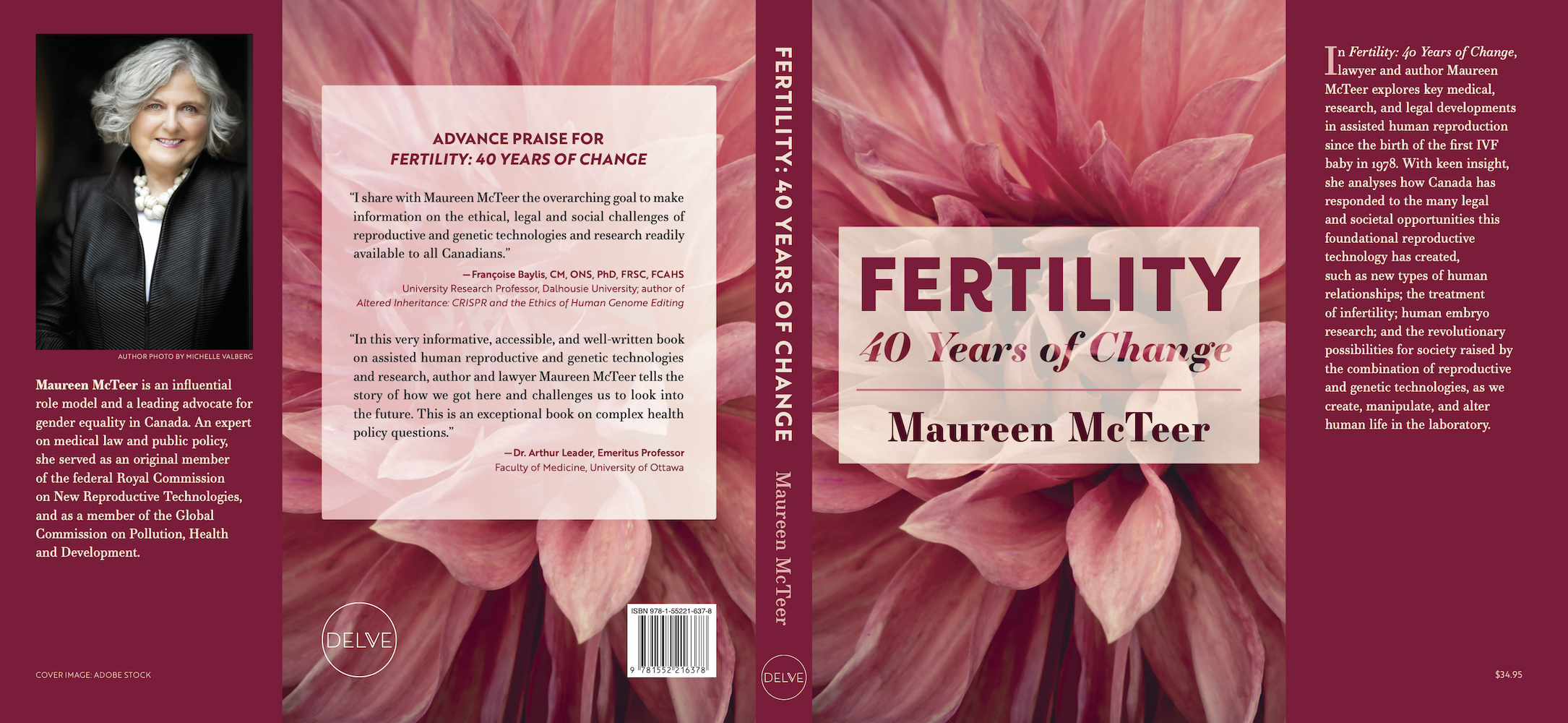
FERTILITY: 40 YEARS OF CHANGE
We are delighted to announce that Maureen McTeer's most recent book, FERTILITY: 40 Years of Change has been published by Irwin Law. This book explores key medical, research, and legal developments in assisted human reproduction since the birth of the first IVF baby in 1978. With keen insight, Maureen analyses how Canada has responded to the many legal and societal opportunities this foundational reproductive technology has created, such as new types of human relationships; the treatment of infertility; human embryo research; and the revolutionary possibilities for society raised by the combination of reproductive and genetic technologies, as we create, manipulate, and alter human life in the laboratory.
More >
WORK-STUDY STUDENT – ASSISTANT COORDINATOR
We’re hiring an Assistant Coordinator. In this role, you’ll support existing projects and will get an opportunity to provide meaningful contributions to our activities, such as our Summer Institute in Health Law and AI, and our conference on Borders, Boundaries and Pandemics.
This position is only available to University of Ottawa students through the work-study program. Seeking excellent writing skills and attention to detail. Full bilingualism would be a significant asset.
For more information and to apply, please log into the Work-Study Navigator and look for job 823.

OPINION: PRIVACY OUTRAGE OVER THE USE OF CELLPHONE DATA BY PUBLIC HEALTH OFFICIALS IS UNWARRANTE
Recent outrage by some members of Parliament about an alleged secret collection of Canadians’ data by the Public Health Agency of Canada illustrates how misguided many are about the various kinds of personal data – and how they should and should not be used. Michael Wolfson writes in the Globe & Mail...
Full text >
See also Canadians’ health data are in a shambles…
Full text >

EXPLORING THE IMPACT OF COVID-19 ON ABORTION CARE IN CANADA
Raywat Deonandan is co-investigator on a new grant-funded project led by Angel Foster: Exploring the Impact of COVID-19 on Abortion Care in Canada: A Mixed-Methods Study Dedicated to Service Delivery and Utilization. The project is funded by the Canadian Institutes of Health Research (CIHR) over a two-year period. You can see Angel Foster along with Melissa Upreti, Joanna Erdman, and CHLPE's Daphne Gilbert in last week's webinar, Rights to Abortion: 2022 and Beyond.
More >

THE NUMBER YOU HAVE CALLED IS NOT IN SERVICE
In recent years, some people with visual impairments have regained some degree of sight with the help of “bionic eyes”. But now the company behind the implants has stopped supporting the technology. Hear how that’s left some people in the dark, from Eliza Strickland, Senior Editor at the tech publication IEEE Spectrum, and CHLPE’s Professor Jennifer Chandler. On CBC's The Current:
Audio >
See also Their Bionic Eyes Are Now Obsolete and Unsupported, in IEEE Spectrum>

MACHINE M.D. – 2022 SUMMER INSTITUTE
Do you want to develop deeper knowledge in health law, policy and ethics to supplement your career or studies? Our Summer Institute is a one-week online program for professionals and university students. No prior experience or legal training is required. In 2022 our focus will be on law and health-related artificial intelligence. The Machine M.D. Summer Institute is slated for May 23–27. Enrolment will be limited—if you think this might be for you, you can sign up here to receive notification when the application portal opens:

SEEKING POST-DOC, AI & HEALTHCARE
The AI + Society Initiative is seeking a skilled and enthusiastic Alex Trebek Postdoctoral Fellow to pursue an innovative research program focused on the legal and ethical aspects of health-related artificial intelligence (AI).

THE CANADA HEALTH ACT IS FAILING PEOPLE WITH MENTAL ILLNESS
According to the Canadian Mental Health Association one in five Canadians is currently living with mental illness. By age 40, half of Canadians have suffered—or are suffering—some form of it. Between 2009 and 2019, there was a 60% increase in emergency department room visits and hospitalizations among adolescents. Only one in five young Canadians gets the treatment needed. The Mental Health Commission of Canada estimates that mental health problems and illnesses cost Canada about $50 billion per year. We can and must do better. Yasmin Khaliq writes in the Ottawa Citizen...

SPENDING MORE ON HEALTH CARE DOES NOT GUARANTEE BETTER HEALTH OUTCOMES
Canada’s federal election results had barely been counted when the Premiers resumed making their well-worn demands for more federal health care money. Instead of thanking Ottawa for the billions it has already provided for fighting COVID-19, or asking for short-term pandemic-related funding, the ritual chorus seeks ever-increasing amounts of money for decades to come. Granted, the need for more money certainly feels urgent right now. A number of provinces are having difficulty even staffing their hospitals, after almost two years of burnout-inducing working conditions for front-line health care workers. However, the premiers’ multibillion-dollar asks have been for unconditional long-term funding, well beyond the scope of the current crisis. It is entirely reasonable to ask them to explain how the money will be used—especially since spending more on health care does not automatically mean better health outcomes. CHLPE's Michael Wolfson writes.
Globe and Mail >
The Good Men Project >

A.I. IN CANADIAN HEALTHCARE: WILL THE LAW PROTECT US FROM BIAS?
AI in healthcare has the potential to improve clinical outcomes, healthcare quality, and objectivity in clinical decision-making. However, it also has the potential to perpetuate or exacerbate discrimination in healthcare by producing outputs on the basis of arbitrary traits such as race, sex, and sexual orientation taken in ways that are not clinically relevant. Such discrimination may arise from any combination of algorithmic bias (bias in coding or the machine learning implementation) or data bias (the use of non-representative training data, including data masking systemic discrimination). If these problems are not mitigated, the benefits of AI in healthcare AI are likely be realized at the expense of marginalized groups. This is a complex problem that requires concerted responses from government as well as private actors...
Bradley Henderson, Colleen M. Flood, and Teresa Scassa write in preprint, hosted on SSRN.
Full text >
Find out more about the Machine M.D. research project >

JUDICIAL INDEPENDENCE AND THE "CYBER PANDEMIC"
Digital technologies are briskly transforming how the law is administered. The eco-system in which courts operate has shifted sharply and precipitously during the pandemic, which dramatically hastened "judicial digitization" on a scale and at a pace that our court system would never have contemplated previously. This has culminated, for example, in court proceedings transpiring on Zoom, Teams and the like. This de facto marriage of convenience may in a word best be characterized as an unstructured partnership prematurely born out of necessity… Karen Eltis writes in the Federmann Cyber Security Research Centre's Cyberlaw Blogospace
Full text >

HOW MUCH DOES SCIENCE INFORM CANADIAN COVID-19 POLICY? THAT DEPENDS.
CHLPE’s Patrick Fafard was interviewed by Markham Hislop on the role of Science Advisory Groups and scientific evidence and advice in general in how governments manage the pandemic.
Video >

VACCINE PASSPORTS/CERTIFICATES – LAW, ETHICS AND POLICY
When vaccine passports or certificates launched in Ontario it was a development welcomed by some and strongly opposed by others. The launch raised a myriad of legal, ethical, privacy, and policy issues as jurisdictions around the world grapple with the continued global pandemic and the unusual requirements of demonstrating vaccination in order to enter some public or private spaces. On September 27 CHLPE's Colleen Flood, Bryan Thomas, and Kumanan Wilson were joined by Vivek Krishnamurthy, Director of uOttawa's Canadian Internet Policy and Public Interest Clinic (CIPPIC), as well as Marie-Eve Sylvestre, Dean of Civil Law. Catch up on the full video of the webinar and discussion here.
Video >
Also hear Colleen Flood on the Law Bytes Podcast, hosted by Professor Michael Geist.
Listen >

PRIVATE HEALTH CARE, PUBLIC SOLUTION?
Ontario's health care system has been battered by COVID-19, medical staff have been pushed to their limits, and there's a massive backlog of diagnostic and surgical procedures built up due to shutdowns. Has the time come for private health care to help fill the gaps? CHLPE Director Colleen M. Flood appeared in a panel on TVO's The Agenda.

OPEN LETTER TO WORLD HEALTH ORGANIZATION ON TOBACCO HARM REDUCTION
Chair of CHLPE's Advisory Board, Professor David Sweanor, as well as CHLPE member Patrick Fafard were among 100 signatories of an open letter to the 182 parties (countries) to the Framework Convention on Tobacco Control to take a more positive stance on tobacco harm reduction. The letter pushes back against WHO’s drive for prohibition or excessive regulation and taxation of vaping products, heated and smokeless tobacco products, and novel oral nicotine products: "Cigarettes and other smoked tobacco products are responsible for the vast majority of the deaths caused by tobacco use globally. Smoke-free nicotine products offer a promising route to reducing the harms arising from smoking. There is compelling evidence that smoke-free products are much less harmful than cigarettes and that they can displace smoking for individuals and at the population level."

CARING OVER THE LIFECYCLE: THE ROLES OF FAMILIES AND WELFARE STATES TODAY AND INTO THE FUTURE
CHLPE's Michael Wolfson is Principal Investigator on WellCare, a CIHR-funded project investigating the future of elder care. WellCare is part of a broader international endeavour headed by the EU under the banner Better Lives, Better Years.
An increasing proportion of the population at higher ages combined with increasing life expectancies and declining birth rates could generate major tensions for meeting Canada's elder care needs by 2050. Such needs are approached by some combination of informal care provided by family members and formal care either privately purchased or from publicly funded government programs. The WellCare project will compare the many ways formal and informal care is provided across four countries—Spain, Austria, the U.K., and Canada. With this analysis, complemented by computer modelling, the project will illuminate alternative approaches to meeting caring responsibilities. A central aspect of the analysis will be inter-generational equity. The results will include new insights and actionable policy ideas for Canada. If you would like to learn more, please get in touch at healthlaw@uottawa.ca.

LEX-ATLAS: COVID-19
CHLPE's Colleen M. Flood and Bryan Thomas are public health sub-editors for Lex-Atlas: COVID-19 (LAC19). With nearly 200 jurists participating, this large-scale international project builds a report and analysis of national legal responses to COVID-19 around the world. National responses have varied considerably. Epidemiological performance is but one measure, and a difficult one to judge when transparency is doubtful. Countries have employed emergency powers differently, but understanding them requires attention to the broader constitutional structure in which they are situated. It is hoped LAC19 will assist policy makers in future pandemic preparedness, to fashion ongoing responses to COVID-19, and to assist scholars and historians to come to evaluative judgments of state responses. The project is also a great source for original news and analysis articles, blog posts, and more.
Read Editorial (part I): Mandatory vaccination and the law (Bryan Thomas, co-author) >
Read Editorial (part II): Conditional policies and vaccine passports (Bryan Thomas, co-author) >
OPINION: THE WORLD HEALTH ORGANIZATION MUST STOP ITS ATTACK ON TOBACCO HARM REDUCTION
Chair of CHLPE's Advisory Board, Professor David Sweanor, was one of four signatories to a letter to the World Health Organization in response to its approach to tobacco harm reduction: "The World Health Organisation puts the death toll from tobacco use at over eight million people annually and suggests an economic cost of US$1.4 trillion in health care burdens and lost productivity. The burning question is what WHO and governments are doing about this. Our concern is that the response of the World Health Organisation is inadequate, based on flawed science and poor analysis, and compromised by special interests..."
Read the letter to WHO >
Accompanying media website >

UNDERSTANDING THE ROLE OF THE CHIEF MEDICAL OFFICER IN A PANDEMIC
As the COVID-19 pandemic took hold in 2020, Chief Medical Officers (CMOs) entered the public spotlight like never before. Amidst this increased visibility, the role is deeply contested. Much of the disagreement concerns whether CMOs should act independently of the government: while some argue CMOs should act as independent voices who work to shape government policy to protect public health, others stress that CMOs are civil servants whose job is to support the government. Such debates about the CMO role can be explained by its inherently contradictory nature, which requires incumbents to balance their commitments as physicians with their mandates as civil servants...
Margaret Macaulay, Patrick Fafard and Adèle Cassola write in the Globe and Mail as well as a deeper take in the Journal of Epidemiology & Community Health.
REGULATING ADAPTIVE MACHINE LEARNING ENABLED MEDICAL DEVICES
Michael Da Silva, Post-Doctoral Fellow at CHLPE and Lead Research Associate on the AI + Society Initiative, has been appointed to a Health Canada external reference group to tackle how to regulate "adaptive machine learning" artificial intelligence (AI) in medical devices. Such AI changes its operation in response to data acquired over time, with the aim of improving its performance. For example, a device for diabetes management could adapt based on how a patient’s body responds to treatment. This is an exciting advance but it also prevents us from fully know how a device's risks will evolve with use. By current Health Canada regulations, this effectively bars such devices from the Canadian market. The reference group will advise on ways to evolve our regulations to open the door to adaptive AI without unduly compromising safety standards.

SUMMER INSTITUTE 2021 WRAPS
CHLPE's first Summer Institute in Health Law ran in August, focussing on issues of COVID-19. The Institute was comprised of 11 morning/afternoon sessions helmed by 14 professors. 33 attendees including students, nurses, physicians, lawyers, policymakers, researchers, and more completed the program. We had hundreds of applications for a very limited number of spots. But this was only the first in an annual series of Summer Institutes, so we look forward to welcoming a new cohort next year. Congrats to our first round of alumni!

COVID-19 VACCINES EXPIRING IN WEALTHY NATIONS AS DEVELOPING WORLD STRUGGLES
While the world’s wealthiest countries are paying hesitant citizens to get vaccinated against COVID-19 and stockpiling vaccine supply for potential booster shots, the developing world is struggling to get even a first vaccine into the arms of its citizens. The fact that some of this supply is about to reach its expiration date just adds insult to injury. Adam Houston writes in BioSpace...
Full text >
Sign up for event notification and newsletter emails
Find us on...



